Reflect & Refract Virtual Roundtable
What Goes Unsaid, and What It Costs:
Coherence and the Senior Team’s Shared Work
Every senior team I have worked with has a short list of things that do not get said.
I want to make a case about what that costs, and it is larger than the meeting it happens in.
Think about what your team has carried in the past three years. A revenue strategy. A governance change. A culture initiative. The articulation of strategic direction.
Each of those is a big lift. Each consumed real money, real time, and most of the team’s attention for a season.
Some produced the traction they were meant to. In my experience a striking number did not, and the explanation is rarely that the strategy was wrong or that the people were not capable.
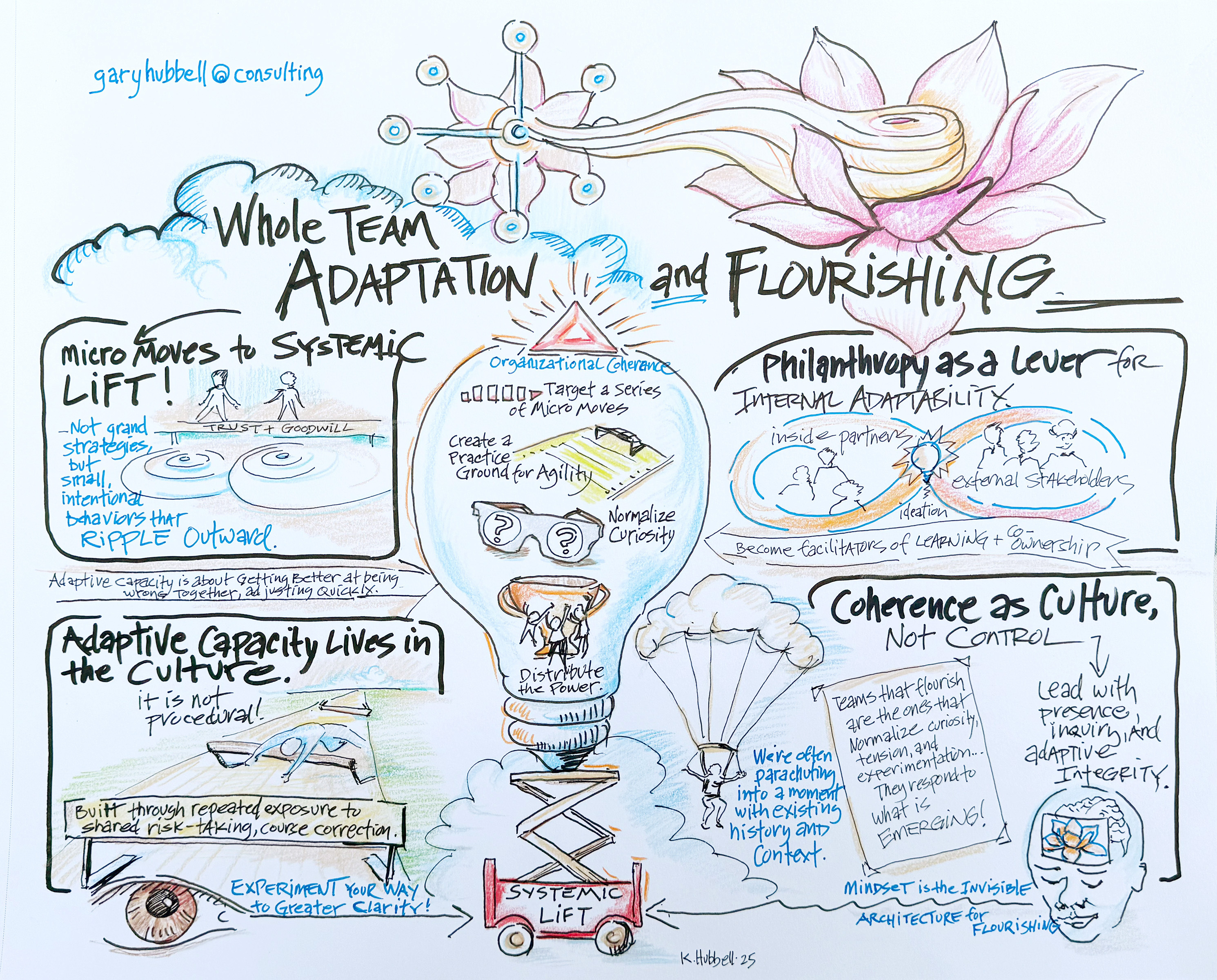
Every one of those lifts is working on an invisible architecture underneath it. The beliefs people hold about what is possible here. The assumptions few have examined in a decade. The questions a meeting permits, and the ones it quietly forbids.
When that architecture does not hold together, a well-made plan meets an organization that can do very little with it.
Margaret Wheatley’s word for what happens when it does hold together is coherence. Here is the definition I use.
Coherence is a condition in which people across an organization share enough meaning that they can act independently and still act consistently, without anyone coordinating them.
Notice what that does not require. It does not require agreement, and it does not require uniformity. Wheatley describes coherence in a living system as rhythm, closer to a jazz group than a marching band. A coherent team can argue all afternoon.
Notice what it makes possible. A revenue strategy carried by a team that cannot talk honestly about what is not working will underperform its own model. A strategic direction handed to an organization with no shared capacity to adapt becomes a binder.
Coherence is what makes the others hold.
I have come to believe it is the condition every big lift depends on, and the one thing a senior team cannot delegate, purchase, or announce into being.
It gets co-created, by the whole team, on purpose, or it does not arrive.
Which brings those unsaid things back into view, with their real significance attached.
What a senior team is able to say to each other is one of the most honest readings available of whether that team has taken the conditions on together.
A team that has will put the unexamined assumption on the table. A team that has not will route around it, courteously, for years, while the work built on top of it quietly underperforms.
So here is the argument I would like examined on October 15. The invisible architecture is the senior team’s shared work, not the leader’s alone and not a consultant’s. Coherence is what that shared work produces. And traction on every big lift the team is carrying depends on coherence at least as much as on the quality of the plans.
What We Will Explore
- What a senior team is able to say to each other, read as evidence about who is carrying the conditions.
- Why capable teams with sound plans still watch their largest commitments underdeliver, and what sits underneath when they do.
- Coherence as I use the term, and how it differs from alignment, agreement, or everyone getting along.
- What it means for a whole senior team to take shared responsibility for the conditions, instead of treating those conditions as the CEO or president’s department.
- The four places where my own argument gets uncomfortable, which I will name before anyone else has to.
“The success of an intervention depends on the interior condition of the intervenor.”
— Bill O’Brien
Gary's Note
I usually bring a guest partner to these. This time I am bringing the question instead.
O’Brien’s sentence has been my true north for years, and on the 15th it applies to me before it applies to anyone who registers.
So I have found four soft spots in my own thinking, and all four go on the table early.
An argument that has only been stated is a different thing from an argument that has been examined. That is most of why I wanted a session on this one.
If something here has already begun arguing back in your head, that is the version of you I would most like to hear from on the 15th.
Series Arc
This year we have come at the same notion from different directions. Christophe Kempkes (April) on the interior conditions of organizations. Mary Ann Allison (May) on how meaning travels through systems. Louis Diez (June) on what stays human when the work changes with AI. Tanja Horan (July) on the practice beneath the practice. Ken Hubbell (August) on leading like an artist of life. Maya Evans (September) on being a strategist rather than doing strategic stuff.
October is where I try to name the pattern beneath the waterline. In November, Courtney Harrness carries it outward, to relationships as community infrastructure.
Who Belongs
Presidents, provosts, and deans. Hospital and system executives. Nonprofit and foundation leaders, executive directors, consultants, and board members.
Anyone who sits on a senior team carrying commitments large enough that their success depends on more than the quality of the plan.
And anyone who has watched a team go quiet and wondered what that silence was going to cost later.
You do not need a senior team of your own to find this useful. Most of us have been on both sides of that silence.
Session Format
Seventy-five minutes, conversational and participatory.
I open with the argument and the four places I think it may be weakest. About twenty minutes.
Then a few private minutes with one commitment your own team is carrying right now. Nothing is collected and nothing has to be shared.
Then small breakout groups, working one question with peers. What is not being said about that commitment, and what conditions would have to exist for it to be said well?
Then open exchange, where I expect my argument be examined and where I would be disappointed if I were not.
Live only. I record for internal purposes, and no replay is distributed.
The Flourishing Framework Connection
The Flourishing Framework is the lens I bring to this work. Organizations reliably produce what they are designed to produce, and that design lives mostly below the waterline, in beliefs, assumptions, and daily habits that belong entirely to the people inside.
The orientation throughout is appreciative. A team spends more time on what is already working, and on the invisible conditions that keep producing it, than on what is broken.
My longer work exists for the reason this session names. A senior team that co-creates its own invisible architecture gives the organization coherence, and coherence is what its revenue strategy, its governance decisions, its culture work, and its strategic direction all depend on.
Nothing about this session asks anything further of you. If you would like to see that longer work, it is an eight-month engagement I lead for a CEO or president and their senior leadership team, cultivating the invisible architecture of change together, and the full arc is at garyhubbellconsulting.com/tff.